
E1: US Response to COVID-19 & Impact on Startups, VC & Public Markets with David Friedberg
TL;DR
- Panel explores whether the US overreacted or underreacted to COVID-19 in early 2020, examining policy directives and statistical data
- Discussion of potential treatment options, policy changes, and comparison of US response to Chinese and South Korean quarantine strategies
- Analysis of immediate impacts on startups and venture capital funding as market conditions deteriorate in real-time
- Examination of capital markets collapse, mass-testing capabilities, and the problem of corporate bailouts for companies that manipulated earnings through stock buybacks
- Broader systemic issues exposed by the pandemic including gaps in the US healthcare system and global supply chain vulnerabilities
- Predictions on economic recovery timeline, including when restaurants, markets, and normal social activities may resume
Episode Recap
This early pandemic episode features a panel discussion between David Friedberg and Chamath Palihapitiya examining the US response to COVID-19 and its cascading effects on the economy, markets, and startup ecosystem. The conversation begins with personal quarantine experiences before pivoting to substantive analysis of whether government responses were proportionate to the threat. The panelists debate the merits of different international approaches, particularly comparing US strategies to those employed by China and South Korea, whose more aggressive testing and quarantine measures were producing different results.
A significant portion of the discussion focuses on the real-time market collapse occurring during the recording, with Chamath explaining the mechanisms driving the dramatic sell-offs and what they mean for capital allocation. The panelists examine how traditional venture capital models face disruption when founders cannot access growth capital, and what this means for startup survival and innovation pipelines. They explore the disconnect between the scale of the crisis and the adequacy of existing safety nets.
The conversation shifts to technical challenges facing the US pandemic response, particularly the shocking inadequacy of mass testing capabilities despite advanced technology and resources. This limitation constrains policy options and creates uncertainty in modeling disease spread. The panelists also address the controversial aspect of corporate bailouts, questioning the fairness and logic of rescuing companies that manipulated their earnings-per-share ratios through aggressive stock buyback programs, effectively using shareholder capital for financial engineering rather than building resilience.
Broader structural issues emerge throughout the discussion, including how the pandemic exposed fundamental weaknesses in the US healthcare system's capacity and distribution. The panelists discuss whether the crisis should prompt policy changes regarding global food supply chains, particularly around wet markets and wildlife commerce. Economic relief mechanisms receive scrutiny, including whether monthly stipends to low-income citizens would be more effective than selective corporate bailouts.
The episode concludes with playful speculation about timeline recovery, including predictions about when Americans might safely return to restaurants and resume normal social activities like weekly poker games. Throughout the discussion, the panelists demonstrate how a genuine crisis forces examination of previously accepted economic and policy assumptions, revealing which systems function as designed and which require fundamental rethinking.
Key Moments
Notable Quotes
“The real question is whether we're responding proportionally to the actual threat or if we're being driven by fear and uncertainty”
“When the capital markets freeze, startup funding dries up immediately, and that creates a cascade effect across the entire innovation ecosystem”
“We should be asking hard questions about why we cannot rapidly scale testing in a country with our technological capabilities”
“Companies that spent years buying back their own stock to manipulate earnings should not be first in line for bailouts”
“This crisis is exposing every structural weakness in our systems that we've been ignoring for years”
Full Transcript▼
Related Episodes

Bryan Johnson did the world's strongest psychedelic drug... here's how it went

AI Is Killing Brands (And Most Companies Have No Idea)
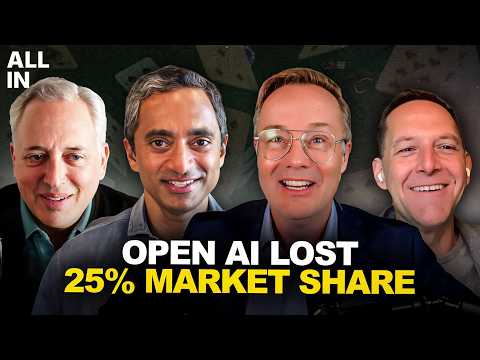
Anthropic's Generational Run, OpenAI Panics, AI Moats, Meta Loses Major Lawsuits
Anthropic is experiencing a generational run with strong momentum in the AI market, positioning itself as a formidable competitor to OpenAI