
Iran War, Oil Shock, Off Ramps, AI's Revenue Explosion and PR Nightmare
TL;DR
- Iran War escalation creates significant economic uncertainty with potential oil shocks affecting inflation and midterm elections
- Geopolitical off-ramps require coordination between the US, Gulf states, and careful consideration of China's interests
- Anthropic and OpenAI are scaling revenue faster than any company in history, demonstrating AI's massive commercial potential
- AI companies face significant PR challenges despite revolutionary technological achievements and rapid adoption
- Washington's new millionaire tax drives wealthy individuals like Howard Schultz to relocate from high-tax states
- Markets are pricing in various geopolitical scenarios through prediction markets and commodity futures
Episode Recap
This episode of the all-in podcast features Brad Gerstner from Altimeter Capital discussing multiple converging macro trends reshaping markets and politics. The panel opens with a detailed analysis of the Iran War's economic implications, exploring how military escalation could trigger oil supply shocks similar to historical crises. They discuss realistic scenarios where oil prices spike significantly, impacting inflation rates just as voters head to the polls for midterm elections. The geopolitical discussion shifts to potential off-ramps from escalation, emphasizing the critical role Gulf states could play as mediators and the often overlooked significance of China's interests in regional stability. Brad Gerstner provides insights on how different stakeholders might engineer a de-escalation without appearing weak domestically.
The conversation pivots to artificial intelligence, where the panel highlights an extraordinary business phenomenon. Anthropic and OpenAI are experiencing revenue growth curves that have never been achieved by any major company in history. The rapid monetization of AI capabilities is creating business opportunities at an unprecedented scale, with both companies scaling to billions in revenue projections. However, this explosive growth comes with a significant caveat: AI companies face a PR nightmare despite delivering genuinely transformative technology. The panel explores why public perception lags behind technological reality, discussing concerns about job displacement, environmental impact, and general public anxiety about artificial intelligence. They also examine open source AI's role in this landscape and how it might evolve.
The final segment addresses domestic policy changes with immediate practical consequences. Washington's passage of a millionaire tax represents a significant shift in wealth taxation policy. This prompts discussion about Howard Schultz's decision to relocate from Washington to Miami, exemplifying how high earners respond to punitive tax regimes. The panel explores broader implications of wealth taxation on state competitiveness and capital flight patterns. Throughout the episode, the besties reference multiple data sources including commodity prices, prediction markets tracking geopolitical outcomes, inflation expectations, and midterm election odds. The discussion maintains focus on how these interconnected issues create both risks and opportunities for investors and policymakers. The episode demonstrates how macro conditions, geopolitical events, technological disruption, and policy changes operate as an integrated system affecting markets, politics, and business strategy.
Key Moments
Notable Quotes
“Anthropic and OpenAI are scaling revenue faster than any company ever has in history”
“AI has a massive PR problem despite being genuinely transformative technology”
“Off-ramps from escalation require coordination with Gulf states and understanding China's interests”
“The Iran War creates a direct political risk to the midterms through oil prices and inflation”
“Capital flows follow tax policy, and wealthy individuals are responding rationally to punitive taxation”
Full Transcript▼
Related Episodes

“Stop Blaming Everyone Else”: David Friedberg on Personal Agency in the Age of AI

AI Is Killing Brands (And Most Companies Have No Idea)
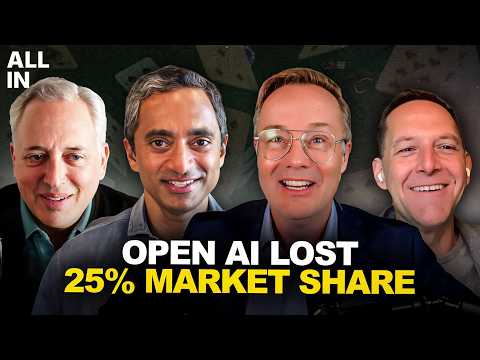
Anthropic's Generational Run, OpenAI Panics, AI Moats, Meta Loses Major Lawsuits
Anthropic is experiencing a generational run with strong momentum in the AI market, positioning itself as a formidable competitor to OpenAI